Checking Which Ad a News Page Shows Readers in Four Countries
Say you’ve paid for a campaign that should run in Germany and France and nowhere else. The dashboard says it’s live. But the dashboard is the ad network’s word for it. The only way to be sure is to load the page as a reader in each country would.
Doing that by hand means a VPN, switching countries, clearing cookies between tries, and screenshots you line up later. Unweb does it in one window. A saved setup holds four strangers, each with its own location. You open the setup and type the address once.
This case study uses a made-up news page with one ad slot. The ad depends on the country the reader seems to come from. The example server includes three stand-in proxies that tell the page the reader is in Germany, France or Spain. A real ad server would work that out from the IP address.
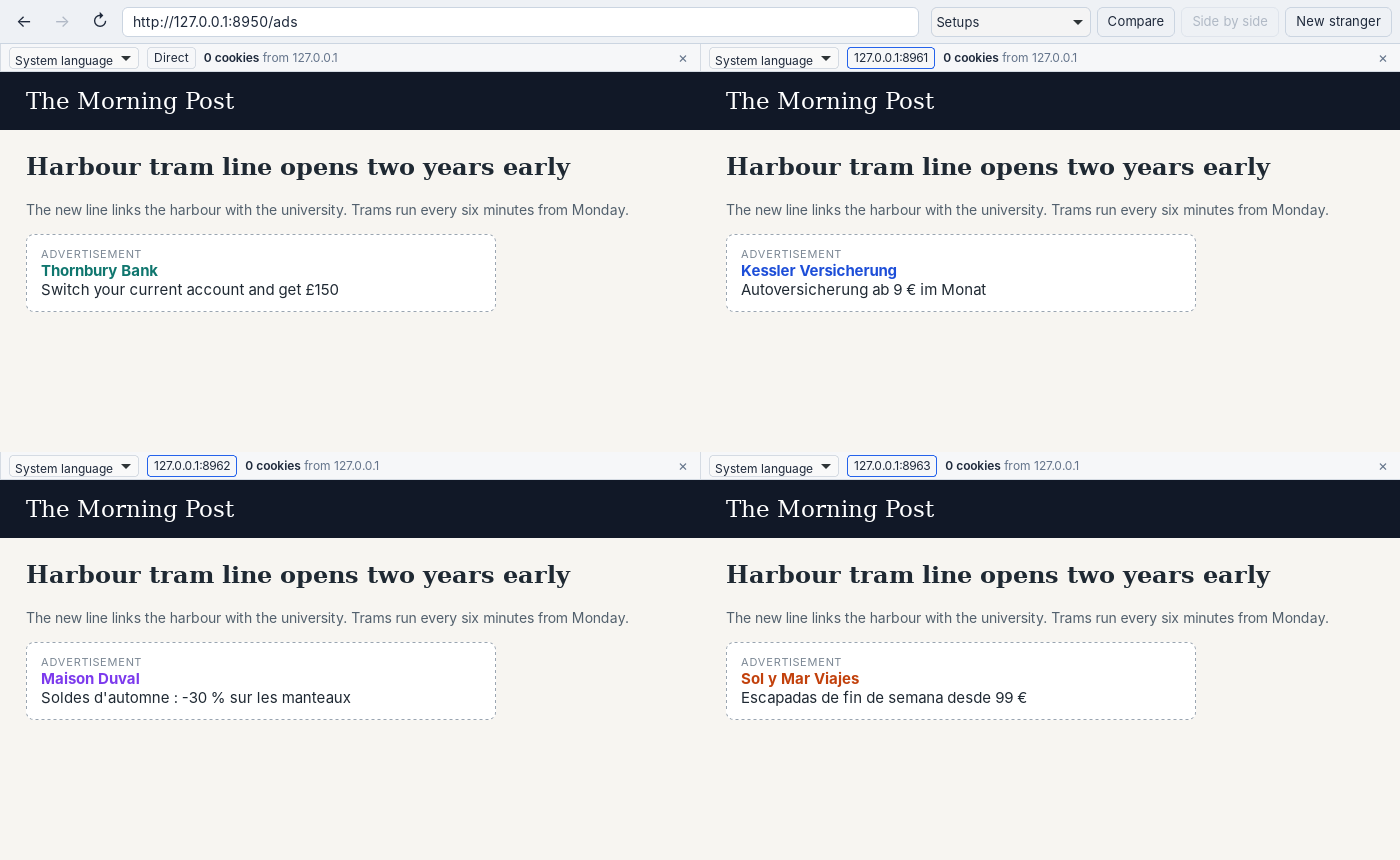
One address, four strangers, four locations. Each strip shows the proxy that stranger goes through.
What It Shows
The same article in all four, and a different ad in each. The German reader gets the insurer, the French reader the coat sale, the Spanish reader a travel offer, and the stranger with no proxy gets a bank. None of them has a cookie from the site, so nothing a previous visit left behind is steering the result. The location is the only thing that changed.
If the German ad turned up in the Spanish stranger too, you’d have your answer about the campaign’s targeting, in one screenshot.
Trying It on a Real Site
Save a setup with a stranger for each country you’re buying. You need a proxy in each of them; Unweb takes http:// and socks5:// addresses. Open the setup, type the page’s address, and click Compare to keep the result as one image. Run it the next day from the same setup, and every stranger starts empty again.
Two things to keep in mind. A location doesn’t change the stranger’s time zone or language, so an ad that also targets by language may differ from what a real local reader sees. On macOS, a stranger whose proxy is down sends its requests direct, so check your proxies there first.
The news page and the three stand-in proxies are in examples/case-studies. Run python3 server.py, give strangers the locations 127.0.0.1:8961, 127.0.0.1:8962 and 127.0.0.1:8963, and open http://127.0.0.1:8950/ads.